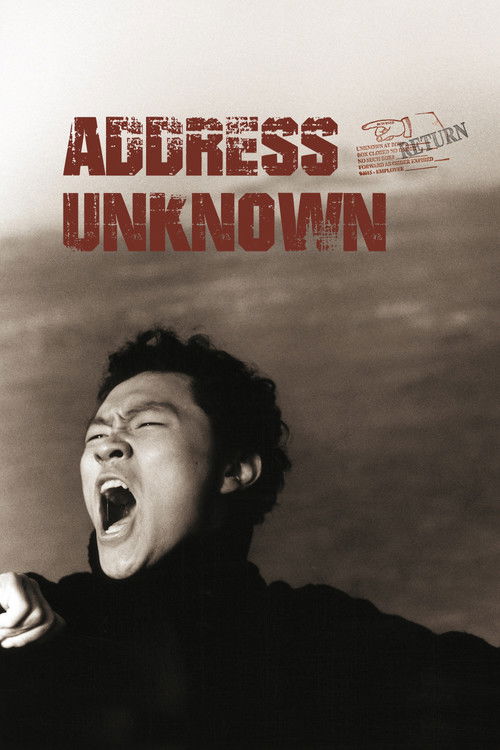
Address Unknown
dir. Kim Ki-duk · 2001
The struggle for connection and understanding amidst the scars of history reveals the enduring impact of conflict on human relationships.
"Address Unknown" is a harrowing exploration of love and loss amidst the haunting echoes of Korea's tumultuous history. With its stark imagery and powerful narrative, it immerses viewers in the cyclical despair of a nation weighed down by its past.
Romances end in blood and the frail hopes of individuals are torn apart in a vile karmic continuity of colonialism, civil war and occupation. After surviving Japanese colonization, Korea became the first war zone of the Cold War. The legacy of war remains today in this divided country.
Behind the film
Address Unknown is set around 1970 in a village beside a US military base, where Chang-guk lives in a derelict Air Force bus with his Korean mother. His father is an African-American soldier who went home, and the Korea of those years had no place for a boy like him in its families, its laws or its army.
Mixed blood, in a nation of one blood
Postwar South Korea defined itself as one people by blood, and Syngman Rhee's government sent mixed-race children overseas under a policy of one nation, one people. About 40,000 mixed-race Koreans were born between 1955 and 1969, most of them fathered by American soldiers. They were called honhyeol, mixed blood, or the slur twigi, and people assumed their mothers were camptown sex workers. Children with Black fathers had it worst: adults interviewed by the Korea Herald in 2016 remembered being spat on and hit as children.
A son with no nationality
Until June 1998, Korean nationality passed only through the father. A child born to a Korean mother and an American soldier had no claim to it, and many children of US soldiers were legally stateless. In Address Unknown, Chang-guk's mother writes to his father in America, and every letter comes back stamped with the film's title.
Kept out of the army
For a Korean man, military service is a rite of passage into full membership of the nation. A 1972 law exempted mixed-race men from compulsory service, with the aim of encouraging them to emigrate. The exemption stood until 2010, when the Military Service Act was revised to cover every Korean national regardless of race or skin colour.
Why his mother teaches him English
America was the way out the country offered. Holt, the adoption agency founded in 1956, was set up to place mixed-race Korean babies with American families, and in the decade after the Korean War most Korean children adopted abroad were Amerasian. In 1982 the US Amerasian Immigration Act gave priority to the children of American soldiers, and a survey that year found 95 percent of mixed-race Koreans wanted to go. Chang-guk's mother teaches him English for a life in the United States.
The town around the base
Camptowns grew up around American bases and lived off them, through clubs, bars and brothels serving the troops. In 2022 South Korea's Supreme Court ruled that the state had promoted prostitution in the camptowns from 1957 to 2008 to keep American troops in the country and bring in dollars, and it upheld damages for 117 women. Officials had even taught the women English.
The clubs were divided by race, and Korean owners did the dividing. Near Camp Humphreys only one of the four largest clubs served Black soldiers, who were a third of the base. In July 1971 Black soldiers wrecked the clubs at Anjeong-ri, and Korean villagers gathered outside the base carrying banners with messages like "black black black" and "Go back to cotton fields". Chang-guk grows up Black in a camptown built on that same divide.
Sources
- Korea Herald, 27 April 2016, on Koreans born to US soldiers: the numbers, the slur, the 1972 conscription exemption and the 1982 Amerasian Immigration Act: www.koreaherald.com/view.php?ud=20160427000713
- Matt VanVolkenburg, Korea Times, 23 June 2020, on the segregated camptown clubs and the July 1971 riots: www.koreatimes.co.kr/southkorea/globalcommunity/20200623/korea-e
- Library of Congress, on the 2022 Supreme Court ruling that the state promoted camptown prostitution: www.loc.gov/item/global-legal-monitor/2023-01-11/south-korea-sup
- South Korean nationality law, on nationality passing only through the father until June 1998: en.wikipedia.org/wiki/South_Korean_nationality_law
- Migration Mobilities Bristol, on conscription, race and who counted as Korean by blood: migration.bristol.ac.uk/2025/02/24/call-to-arms-but-to-whom-cons
- International adoption of South Korean children, on Holt and the Amerasian adoptees of the 1950s: en.wikipedia.org/wiki/International_adoption_of_South_Korean_chi
- Washington University Global Studies Law Review, on legal reform and interracial Koreans: journals.library.wustl.edu/globalstudies/article/id/42/download/
- Korean Film Council and AsianMovieWeb, on the film's setting and characters: www.koreanfilm.or.kr/eng/films/index/filmsView.jsp?movieCd=20010