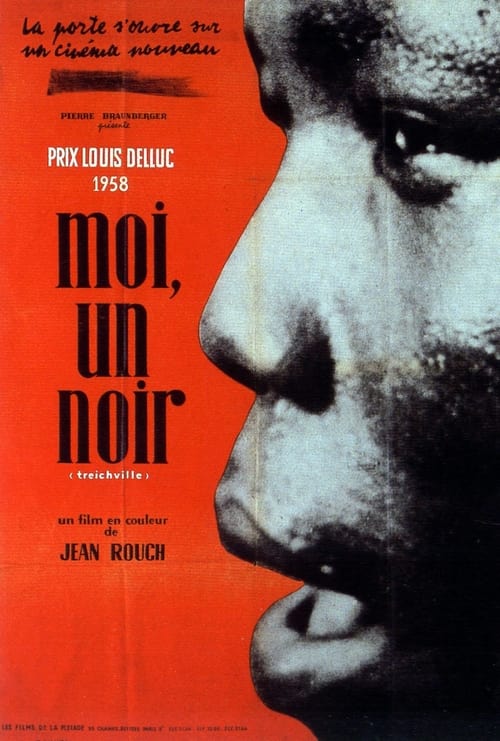
I, a Negro
dir. Jean Rouch · 1959
The struggle for dignity and fulfillment in life often leads individuals to dream of better circumstances while grappling with harsh realities.
Young men in Treichville wake each day to seek work, their hopes tethered to the meager 20 francs needed for a bowl of soup. As they navigate the squalor of their surroundings, their dreams manifest in surreal, poetic sequences where they become heroic alter-egos, momentarily escaping their harsh realities. Watching this film is like stepping into a dreamscape where the weight of aspiration collides with the starkness of everyday life.
"I, a Negro" depicts young Nigerien immigrants who left their country to find work in the Ivory Coast, in the Treichville quarter of Abidjan, the capital. These immigrants live in squalor in Treichville, envious of the bordering quarters of The Plateau (the business and industrial district) and the old African quarter of Adjame. The film traces a week in these immigrants' lives, blurring the line between their characters' routines and their own. Every morning, Tarzan, Eddy Constantine and Edward G. Robinson seek work in Treichville in hopes of getting the 20 francs that a bowl of soup costs them. They perform menial jobs as dockers carrying sacks and handy labor shipping supplies to Europe. At night, they drink away their sorrows in bars while dreaming about their idealized lives as their "movie" alter-egos, alternatively as an FBI Agent, a womanizing bachelor, a successful boxer, and even able to stand up to the white colonialists that seduce away their women. These dream-like sequences are shot in a poetic mode. Each day is introduced by an interstitial voice of god omniscient narration from Jean Rouch, providing a universal thematic distance to the movie's events. The film is book-ended by a narration directed at both Petit Jules and the audience from Edward G. Robinson fondly looking back on his childhood in Niger and concluding that his life is worthy of his dreams.
Talking points
- the immigrant experience in urban settings
- the role of dreams in shaping identity
- the impact of colonialism on personal aspirations
- the intersection of reality and performance in daily life